
From Surface Defects to Structural Defects: The Evolution of Metal Inspection with Computer Vision
In the metal processing industry, quality control has always played a crucial role in ensuring product safety, reliability, and compliance. However, as production processes become more complex and market expectations continue to rise, traditional inspection methods are no longer sufficient.
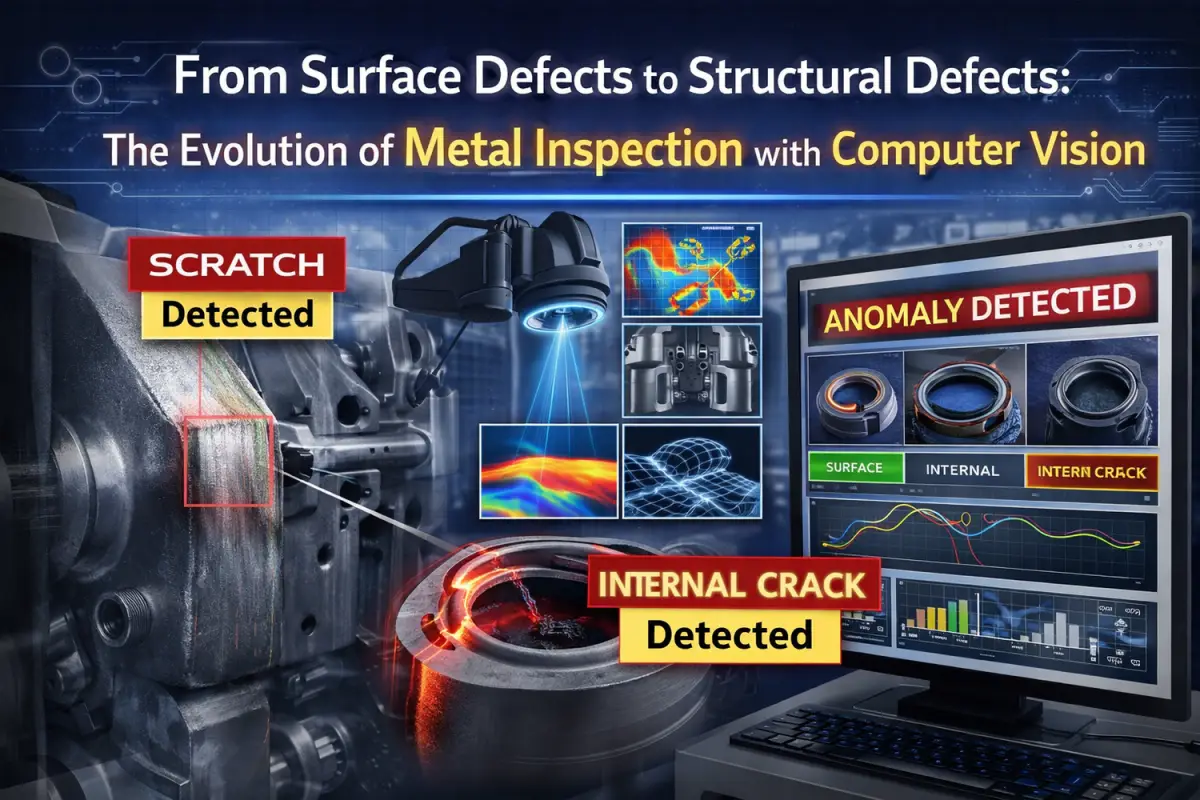
Today, thanks to Computer Vision and Artificial Intelligence, metal inspection is undergoing a major transformation: from simple detection of surface defects to the identification of more complex structural anomalies.
This evolution represents a significant leap forward, enabling manufacturers to dramatically improve process control and final product quality.
From Surface Inspection to Traditional Limitations
Historically, metal inspection has focused primarily on visible surface defects such as:
-
scratches
-
dents
-
surface inclusions
-
oxidation
-
finishing imperfections
These inspections were typically performed through:
-
manual visual inspection
-
traditional optical systems
-
sample-based checks
While useful, these approaches present several limitations:
-
dependency on operator experience
-
inability to inspect 100% of production
-
difficulty detecting very small defects
-
inability to identify internal or structural issues
The Evolution with Computer Vision
The introduction of Computer Vision has revolutionized how metals are inspected.
Modern systems use:
-
high-resolution cameras
-
advanced lighting (laser, structured light)
-
image analysis algorithms
-
Deep Learning models
This enables a shift from purely visual inspection to a more comprehensive and intelligent analysis of materials.
Advanced Detection of Surface Defects
With Computer Vision, it is now possible to detect surface defects with extremely high precision.
Systems can identify:
-
micro-scratches invisible to the human eye
-
texture variations
-
polishing defects
-
coating imperfections
-
surface contamination
All of this happens in real time and across 100% of production, eliminating the limitations of manual inspection.
Toward Structural Defect Detection
The real evolution lies in the ability to detect not only surface defects but also indicators of structural issues.
By integrating with advanced imaging techniques and predictive AI models it becomes possible to detect:
-
hidden deformations
-
internal stresses
-
forming defects
-
anomalies in material structure
How Advanced Inspection Systems Work
A modern Computer Vision-based metal inspection system typically involves several stages.
-
Data Acquisition
Cameras and sensors capture images and data from materials along the production line.
-
Intelligent Analysis
Algorithms analyze visual data and identify abnormal patterns by comparing them with reference models.
-
Defect Classification
The system distinguishes between:
-
surface defects
-
structural defects
-
critical anomalies
-
Action and Feedback
The system can:
-
reject non-compliant products
-
trigger alerts
-
provide feedback to the production process
Benefits of Intelligent Metal Inspection
The transition to AI-based inspection systems offers numerous advantages.
✔ Comprehensive Material Control
Inspection goes beyond the surface to include material behavior and structure.
✔ Higher Precision
Ability to detect microscopic and complex defects.
✔ Reduced Scrap
Early detection of anomalies prevents defective batches.
✔ Improved Production Processes
Data analysis helps optimize manufacturing parameters.
✔ Predictive Approach
Capability to anticipate issues before they occur.
Industrial Applications
These systems are widely used across various industries, including:
-
sheet metal processing
-
automotive component manufacturing
-
steel production
-
CNC machining
-
pipe and profile production
In all these applications, material quality is a critical factor.
The Future: Integration and Intelligence
Metal inspection will continue to evolve through integration with:
-
MES systems
-
digital twins
-
advanced analytics
-
artificial intelligence
Factories will become increasingly:
-
connected
-
intelligent
-
autonomous
Quality control will no longer be a standalone activity, but an integral part of a fully digitalized production system.
Conclusion
Metal inspection is evolving from a surface-focused approach to a comprehensive and intelligent understanding of materials.
Computer Vision, combined with AI, now enables defect detection with unprecedented precision, improving quality, efficiency, and reliability.
In an increasingly competitive industrial environment, this evolution is not just a technological advantage—it is a strategic lever to ensure safer, higher-performing products.
Want to know more? Contact us at info@metalya.it