
Automated Inspection of Glass Bottles
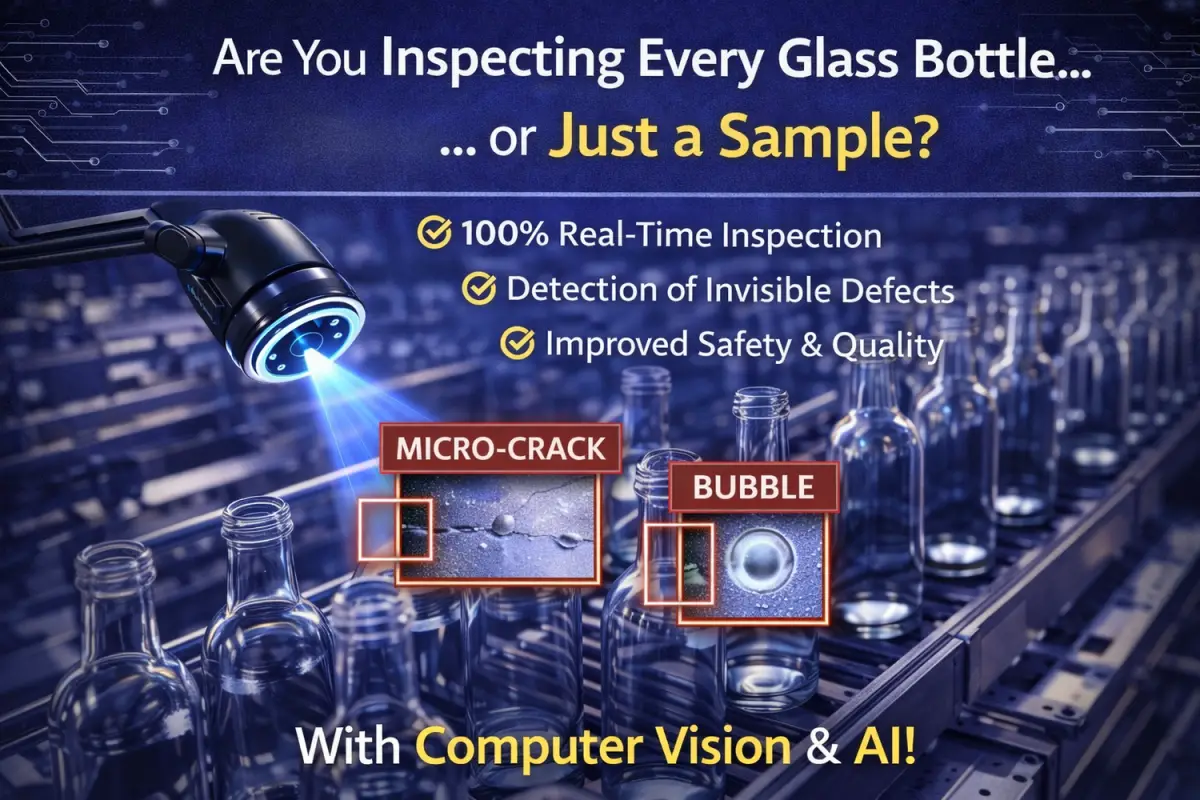
In the packaging industry, glass bottles are widely used for food, beverages, cosmetics, and pharmaceutical products. Their quality is critical not only for aesthetic reasons, but also to ensure safety, product integrity, and regulatory compliance.
Even the smallest defect can compromise the strength of the container or cause issues during filling and transportation. For this reason, more and more manufacturers are adopting automated inspection systems based on Computer Vision, capable of inspecting every bottle in real time along the production line.
Why Glass Bottle Inspection Is Critical
Glass bottles must meet strict requirements in terms of:
-
structural integrity
-
dimensional consistency
-
aesthetic quality
-
absence of contamination
Undetected defects can lead to:
-
breakage during filling
-
product leakage
-
contamination
-
safety risks
-
product recalls
In industries such as food & beverage and pharmaceuticals, these risks are especially critical.
Common Defects in Glass Bottles
During the manufacturing process, several types of defects may occur.
The most common include:
-
bubbles and inclusions in the glass
-
micro-cracks
-
neck and thread defects
-
dimensional irregularities
-
scratches and surface imperfections
-
internal or external contamination
Many of these defects are difficult to detect manually, especially on high-speed production lines.
Limitations of Traditional Inspection Methods
Traditional methods include:
-
manual visual inspection
-
sample-based checks
-
offline measurement tools
These approaches present significant limitations:
-
subjectivity and variability
-
difficulty detecting micro-defects
-
lack of continuous inspection
-
delayed identification of problems
How Automated Inspection with Computer Vision Works
Computer Vision systems enable automatic inspection of every bottle along the production line.
1️⃣ Image Acquisition
High-speed cameras and sensors are installed at key points along the line.
Lighting is designed to highlight:
-
transparency variations
-
reflections
-
surface and internal defects
2️⃣ Image Analysis
Algorithms analyze images to detect anomalies.
The system can identify:
-
inclusions and bubbles
-
micro-cracks
-
neck defects
-
contamination
-
deformations
With AI and Deep Learning, even complex defects can be detected.
3️⃣ Defect Classification
Defects are classified based on:
-
type
-
position
-
severity
This enables fast and accurate decision-making.
4️⃣ Automatic Action
The system can:
-
reject defective bottles
-
trigger alerts
-
record data for analysis
-
provide feedback to the production process
Benefits of Automated Inspection
Implementing Computer Vision provides several advantages.
✔ 100% Production Inspection
Every bottle is inspected in real time.
✔ Higher Precision
Detection of defects invisible to the human eye.
✔ Reduced Scrap
Immediate identification of anomalies.
✔ Process Improvement
Data analysis helps optimize production.
✔ Increased Safety
Reduced risk of defective products reaching the market.
Industrial Applications
Automated inspection of glass bottles is used in:
-
food & beverage industry
-
cosmetics
-
pharmaceuticals
-
industrial packaging
In all these sectors, quality and safety are essential.
The Future: Intelligent Inspection
Advances in AI and Computer Vision will lead to increasingly advanced systems.
Manufacturers will be able to:
-
predict defects before they occur
-
correlate anomalies with process parameters
-
integrate inspection with MES systems
-
automatically optimize production
Conclusion
Inspection of glass bottles is a critical step in ensuring product quality, safety, and reliability.
Computer Vision enables manufacturers to automate this process, delivering fast, accurate, and continuous inspection of every bottle produced.
In an increasingly quality-driven and efficiency-focused industrial environment, automated inspection represents a strategic lever to reduce defects, improve processes, and ensure high standards.